


The El Niño Southern Oscillation (ENSO) is one of the most important climatic phenomena on Earth.
By influencing global temperatures and precipitation, the El Niño/Southern Oscillation (ENSO) significantly impacts Earth’s ecosystems and human societies. El Niño and La Niña are opposite extremes of the ENSO, which refers to cyclical environmental conditions that occur across the Equatorial Pacific Ocean. These changes are due to natural interactions between the ocean and atmosphere. Sea surface temperature, rainfall, air pressure, atmospheric and ocean circulation all influence each other.
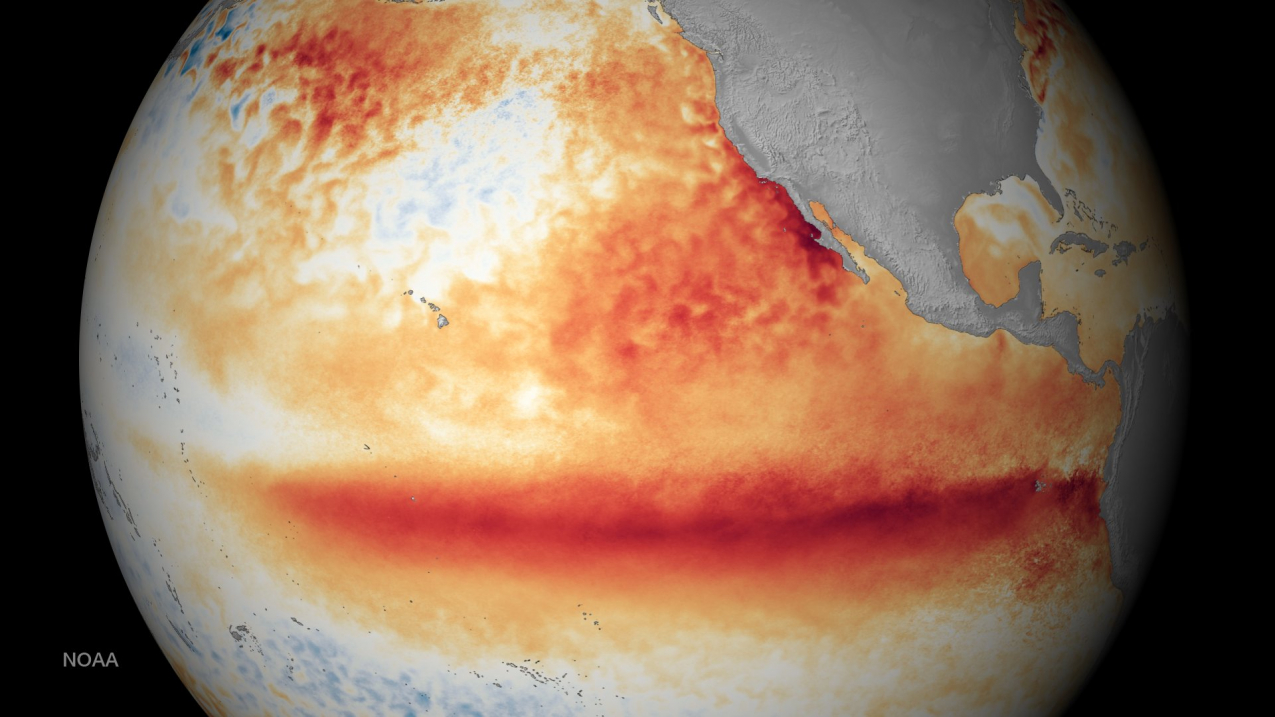
Satellite sea surface temperature departure in the Pacific Ocean for the month of October 2015, where darker orange-red colors are above normal temperatures and are indicative of El Niño. (Image credit: NOAA)
What is El Niño? What is La Niña?
An El Niño condition occurs when surface water in the equatorial Pacific becomes warmer than average and east winds blow weaker than normal. The opposite condition is called La Niña. During this phase of ENSO, the water is cooler than normal and the east winds are stronger. El Niños typically occur every 3 to 5 years.

The Pacific Ocean’s El Niño-Southern Oscillation (ENSO) is arguably the most influential climate driver on Earth. Its cycles of warm and cool waters in the central and eastern equatorial Pacific alter where ocean heat is released into the atmosphere, influencing atmospheric circulation, temperatures, precipitation and other weather events that affect agriculture, wildfires and marine fisheries around the globe.
How ENSO impacts humans
El Niño, La Niña, and the neutral condition all produce important consequences for people and ecosystems across the globe. The interactions between the ocean and atmosphere alters weather around the world and can result in severe storms or mild weather, drought or flooding. Beyond “just” influencing the weather, these changes can produce secondary results that influence food supplies and prices, forest fires, and create additional economic and political consequences. Famines and political strife can result from these environmental conditions.

In the 1970s, Bill Quinn of Oregon State University and Klaus Wyrtki of the University of Hawaii made the first attempt to forecast the El Niño/Southern Oscillation (ENSO). While their initial prediction was incorrect, it marked the beginning of a journey toward understanding and predicting one of the most influential climate phenomena on Earth. So, what is El Niño and why is it so important to anticipate the timing of the cycle?
What are some of ENSO's impacts?
Ecosystems and human communities can be positively or negatively affected. For example, in the Southern United States, during the fall through spring, El Niño usually causes increased rainfall and sometimes destructive flooding. La Niña, however, usually causes drier weather in the South, but the Northwest tends to be colder and wetter than average. Even though El Niño occurs in the Pacific Ocean, it often reduces the number of hurricanes that form in the Atlantic Ocean. Conversely, La Niña events tend to be related to an increase in the number of Atlantic hurricanes.
Food production is impacted by ENSO. Changes in ocean temperatures and currents that happen during El Niño impact marine life. This can impact individuals who make a living fishing and consumers who depend on certain fish for food. Agriculture is of course very dependent on climate and weather, as a result ENSO’s influence on rainfall and temperature have important consequences for food production and availability.

NOAA’s Physical Sciences Laboratory research shows how the state of El Niño-Southern Oscillation (ENSO) in autumn—either the warm El Niño or cool La Niña phase—influences where wildfire activity will occur across specific regions of the United States during the following year.
The origin of the name
The origin of the name “El Niño” dates to the 1800’s, when fishermen on the Pacific coast of South America would notice that a warm ocean current would appear every few years. Fish catches would drop drastically, negatively affecting the food supply and livelihood of the communities of coastal Peru. This warm water would arrive around Christmastime. Referring to the birth of Christ, they named the warm ocean waters, El Niño, which means “the boy” in Spanish. Fishing in this region is best during La Niña years when cold upwelling ocean water brings rich nutrients offsite link from the deep ocean, resulting in an increase in the number of fish caught.

Equipped with a suite of specialized meteorological and oceanographic sensors, the two orange, wind-powered craft will rendezvous with two other Saildrones on a 6,000-mile round-trip mission, navigating south to the center of the developing El Niño.
EDUCATION CONNECTION
ENSO provides teachers with the opportunity to have students discover ways that the oceanic and atmospheric systems interact and how those interactions can impact ecosystems and human society. The resources in this collection can be used to help learn about the basics of ENSO, the inter-relationship of Earth systems, the consequences of these interactions, and how to use and analyze data. These resources can be used to teach students how scientists study the complexity of the Earth’s systems and why better El Niño/La Niña forecasts can benefit agriculture, natural resource managers and human communities.